Anaflor Inj. Solution 250 mL
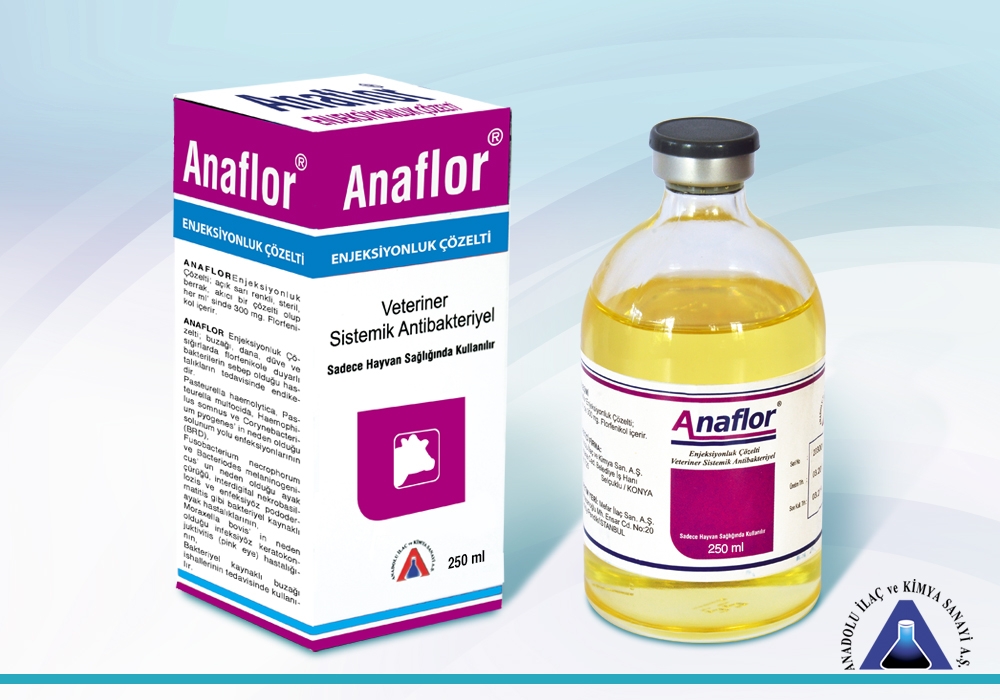
ANAFLOR® 250 ml
Solution for Injection
Veterinary Systemic Antibacterial
COMPOSITION
ANAFLOR Solution for Injection; It is a light yellow, sterile, clear, fluid solution and contains 300 mg Florfenicol in each ml.
PHARMACOLOGICAL PROPERTIES
Florfenicol is a structural analogue of chloramphenicol and is a monofluorinate derivative of thiamphenicol. Florfenicol differs from chloramphenicol in that it carries p-methyl sulfonyl instead of the p-nitro group in its structure and fluorine instead of the primary alcohol at the 3'-carbon atom. In this way, the undesirable effects of chloramphenicol were completely eliminated and its antibacterial activity was expanded. Florfenicol binds to 50S ribosomal subunits in bacteria and has a bacteriostatic effect by inhibiting protein synthesis.
Florfenicol is effective against many gram-negative and gram-positive bacteria. The main bacterial species it is effective on are; Mannheimia haemolytica, Pasteurella multocida, Histophilus somni, Moraxella bovis, Fusobacterium necrophorum and Prevotella melaninogenica.
Florfenicol provides an excellent bioavailability of 88% with parenteral administration. It binds to plasma proteins between 18-22%. It reaches peak plasma concentration in 3-3.5 hours. The elimination half-life is between 18-20 hours. Repeating treatment doses every 36-48 hours may be sufficient to maintain effective plasma drug concentration. 90% of it is excreted unchanged in the urine, and the rest is excreted through the bile.
AREA OF USE / INDICATIONS
ANAFLOR Solution for Injection; It is indicated for the treatment of diseases caused by bacteria sensitive to florfenicol in calves, calves, heifers and cattle.
Respiratory tract infections (BRD) caused by Mannheimia haemolytica, Pasteurella multocida, Histophilus somni,
Bacterial foot diseases such as foot rot, interdigital necrobacillosis and infectious pododermatitis caused by Fusobacterium necrophorum and Prevotella melaninogenica,
Infectious keratoconjunctivitis (pink eye) disease caused by Moraxella bovis,
It is used in the treatment of bacterial calf diarrhea.
USAGE AND DOSAGE
ANAFLOR Solution for Injection; It is administered IM as a single daily dose, 1 ml per 15 kg live weight (with a 20 mg/kg florfenicol dose calculation), and 2 ml per 15 kg live weight (with a 40 mg/kg florfenicol dose calculation) via SC route.
In SC applications, a single dose is sufficient, and in IM applications, the dose should be repeated after 48 hours if necessary.
Practical dosing unless otherwise recommended by the Veterinarian:
Calf………………: 30-90 kg c.a. 2-6ml
Calf-Heifer…………….:150-300 kg b.w. 10-20ml
Cattle……………………:300-600 kg b.w. It is 20-40 ml.
The injection should only be applied to the deep muscle mass in the middle of the neck. More than 10 ml of medication should not be injected into one area.
SPECIFIC CLINICAL INFORMATION AND WARNINGS FOR TARGET SPECIES
It should not be used during milking and pregnancy periods. It can be applied to puppies older than one month.
UNDESIRABLE/SIDE EFFECTS
Inflammation and stiffness may occur at the injection site. During the treatment, the animal's appetite and desire to drink water may decrease. This condition returns to normal spontaneously after the end of treatment, without the need for any other treatment.
DRUG INTERACTIONS
Florfenicol; When used together with lincosamides, erythromycin and other macrolides inhibit each other's effects due to the close proximity of their binding sites on ribosomes. It should not be used together with bactericidal drugs such as penicillin, aminoglycosides, and fluoroquinolones, as they are antagonists.
WARNINGS ABOUT DRUG RESIDUES IN FOOD
Drug Residue Withdrawal Period (i.k.a.s): During the treatment and after the last drug application, in cattle raised for meat; It should not be sent to slaughter within 30 days for intramuscular (IM) applications and 44 days for subcutaneous (SC) applications.
It is not used in lactating animals.
CONTRAINDICATIONS
Since studies on reproduction have not been completed yet, it should not be used in pregnant women and breeding bulls. It should not be used on puppies under one month old.
Use During Pregnancy: The safety of florfenicol in terms of reproductive performance and pregnancy in cattle has not been demonstrated, therefore it should not be used in pregnant animals.
GENERAL WARNINGS
Read the package insert before use.
If an unexpected effect occurs, consult a veterinarian.
Keep it out of reach of children.
SYMPTOMS, PRECAUTIONS AND ANTIDOTE IN OVERDOSE
Its therapeutic index is very wide, and when used in doses 10-15 times higher, a decrease in feed and water consumption and weight gain, sometimes severe diarrhea and dehydration may occur. These symptoms disappear spontaneously when the drug is discontinued.
PRECAUTIONS TO BE TAKEN BY THE PRACTITIONER AND WARNINGS FOR PHYSICIANS
Drug application should be done while wearing rubber gloves. Medicine; It should not be contacted with mouth, eyes and skin. If it does, it should be washed with plenty of soapy water.
STORAGE CONDITIONS AND SHELF LIFE
Store at room temperature (15-25 ºC) and in its packaging. Shelf life is 3 years. Yellowing, which can be seen over time, does not cause loss of activity. Opened packaging should be consumed within 28 days.
COMMERCIAL PRESENTATION
ANAFLOR Solution for Injection; It is presented in 50-100 and 250 ml Type Ι colorless glass vials in a cardboard box with its prospectus.
SALES LOCATION AND CONDITIONS
It is sold in veterinary offices, animal hospitals and pharmacies with a veterinarian's prescription. (VHR)